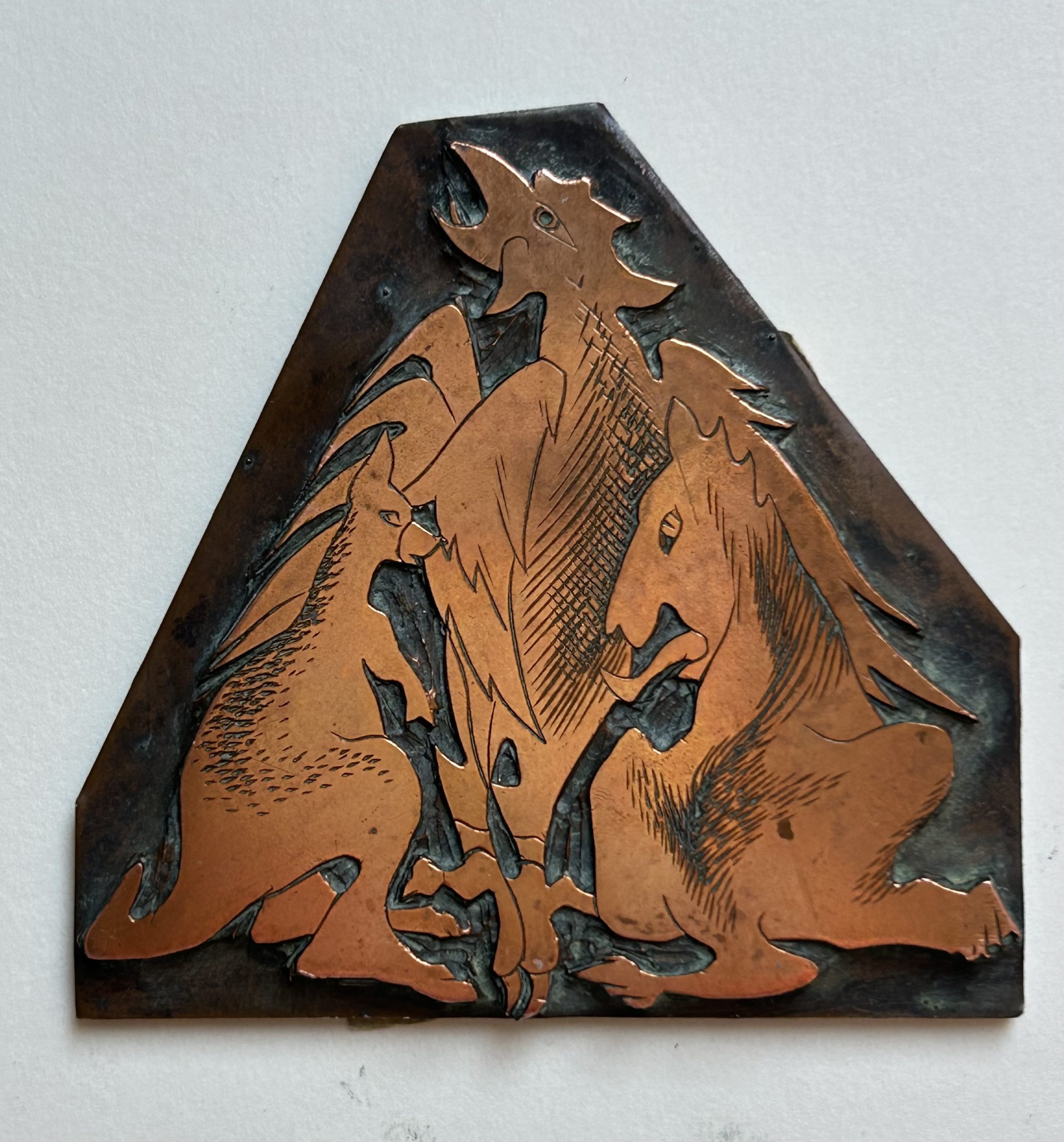
‘Cockarolum P. 112’ SOLD
A device repeatedly used in various publications, though the note hand written on the side of the block, in John Buckland Wright’s handwriting, determines this
John Buckland Wright (1897–1954) was a British printmaker, painter and draughtsman. He worked principally as an etcher and engraver, and was self-taught. Buckland Wright studied history at Oxford and then architecture in London. He soon realised that he wanted to be an artist more than an architect and by 1921 he was living in Belgium and was elected a member of the Gravure Originale Belge in 1925. He was also a member of Xylographes Belges, SWE and LG. During the 1930s, Buckland Wright lived and worked in Paris and frequently visited S W Hayter’s Atelier 17. A master printmaker with an assured, swirling line, Buckland Wright passed on his skills after World War II when he taught at Camberwell School of Arts and Crafts, from 1948, and the Slade School of Fine Art.

A device repeatedly used in various publications, though the note hand written on the side of the block, in John Buckland Wright’s handwriting, determines this

A device repeatedly used in various publications, though the note hand written on the side of the block, in John Buckland Wright’s handwriting, determines this

The original copper engraving plate, measuring 12.7cm x 15.3cm. Inscribed for ‘LL’ and ‘S’, with John Buckland Wright’s initials top centre. Provenance: Golden Cockerel Press.

The “First Fleet” refers to The First Fleet: The Record of the Foundation of Australia from its Conception to the Settlement at Sydney Cove. It

Electrotype copper printing plate measuring 7cm x 8.4cm overall. Electrotyping was a method developed in 1838, a solution to producing extensive print runs from a

Electrotype printing plate measuring 4.7cm x 4.2cm overall. Stamped to edge ‘E&S FED -20- NAT SOC’ denoting Electrotypers & Stereotypers Federation. Electrotyping was a method

The original binding brass which was used to impress the image of the front cover of the published volume ‘L’Apres-Midi D’Un Faune’, 1936. Electrotype printing